Services
WhatsApp automation for businesses (2026)
What works today to automate WhatsApp for your business: AI agents, integration with your systems, and Meta's new rules. With data and examples from Peru.
In Peru and across Latin America, WhatsApp is where your customer already is. Meta reports more than a billion conversations with businesses every day, and by the end of 2025 its paid messaging passed an annualized run rate of US$2 billion. For a business, automating that channel well is a real lever for sales and service.
The interesting part is how much the ground shifted between 2025 and 2026. Meta reworked its pricing model, a new generation of AI agents arrived, and some core rules changed. A guide written a year ago is already out of date. This is the current picture, with the fundamentals and with what is coming.
The basics: what automating WhatsApp really means
Two different products worth keeping apart.
- The WhatsApp Business App is the free app for small businesses: one phone, manual replies, a basic catalog. It is good to start with, and it reaches its ceiling fast.
- The WhatsApp Platform (the API) is the programmable path: it connects to your CRM or your order system, sends templates at scale, and runs an automated assistant. This is where real automation lives. Today you use it through Meta’s Cloud API (the On-Premise version was shut down in October 2025).
Three concepts organize everything:
Message templates and categories. To message a customer first, you use a template approved by Meta, classified as marketing, utility (confirmations, shipping, payments) or authentication (codes). Each category has its own price and rules.
The 24-hour window. When a customer messages you, a 24-hour window opens in which you can reply freely. Outside that window, you need a template again. Almost all good automation is designed around this window.
Consent and quality. You need the customer’s opt-in to message them, and Meta rates your number for quality based on how many people block or report you. If you protect the relationship, your sending limit rises. If you push it with spam, it drops.
What changed in 2025 and 2026
This is where an old guide leads you to bad decisions.
Per-message pricing. Since July 1, 2025, Meta charges for each delivered message, by category and country. The old per-conversation model is gone, along with the monthly bundle of free conversations. In Peru, a utility template runs around US$0.02 per message. And here is something that surprises many: in an AI assistant on WhatsApp, most of the bill is Meta’s messaging; the AI models cost fractions of a cent per message. The real savings are in designing the conversation well.
The 24-hour window is getting more expensive. For a while, replying inside the window was free. Meta confirmed it in its documentation: starting October 1, 2026, it begins charging for messages sent inside the window that used to be free. A support flow that replies for free today may start paying per reply. Automating support is still worth it, and now designing with judgment protects the bill directly: consolidate notices into one, avoid templates you do not need, resolve in few messages.
New features that add up. WhatsApp Flows brings native forms inside the chat (pick a date, book, leave details) without sending the customer to an external link. The Calling API (2025) added voice calls in the same thread. And for selling: catalog and cart live in the chat, though in Peru WhatsApp Pay is not available yet, so payment is handled with an external checkout, a payment link, Yape or Izipay.
The deeper trend: from rule-based chatbots to AI agents
The biggest change is somewhere else: in how capable the assistant is.
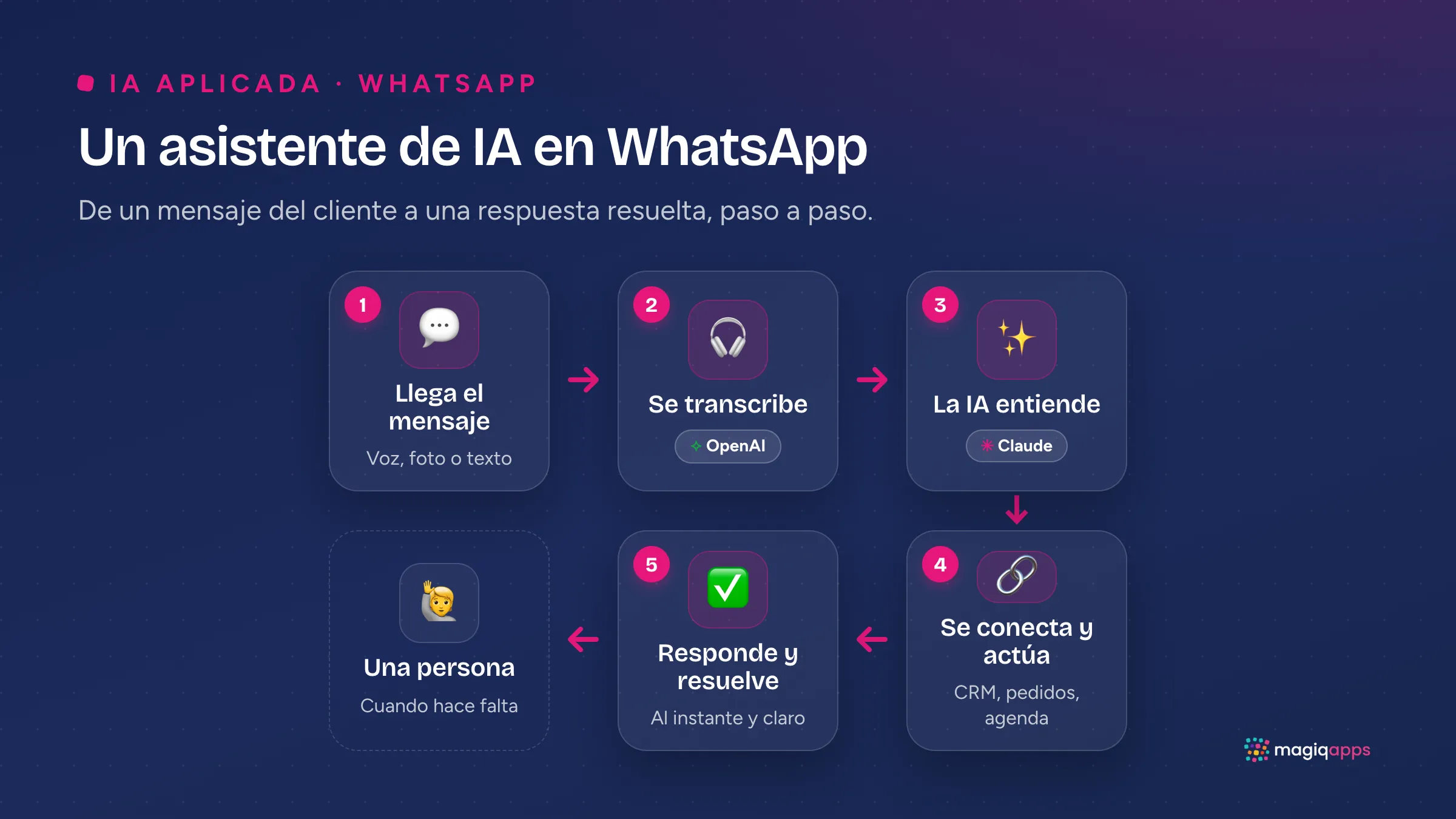
For years a “WhatsApp bot” was a menu tree: “press 1 for sales, press 2 for support”. It broke the moment the customer wrote differently. Today’s generation are AI agents: they understand natural language, remember context from previous days, transcribe voice notes (key in Peru, where audio rules), read the photo of a product or a receipt, and above all take actions: they check your inventory, confirm an order, book an appointment, put together a quote. When a case is beyond them, they hand off to a person with full context.
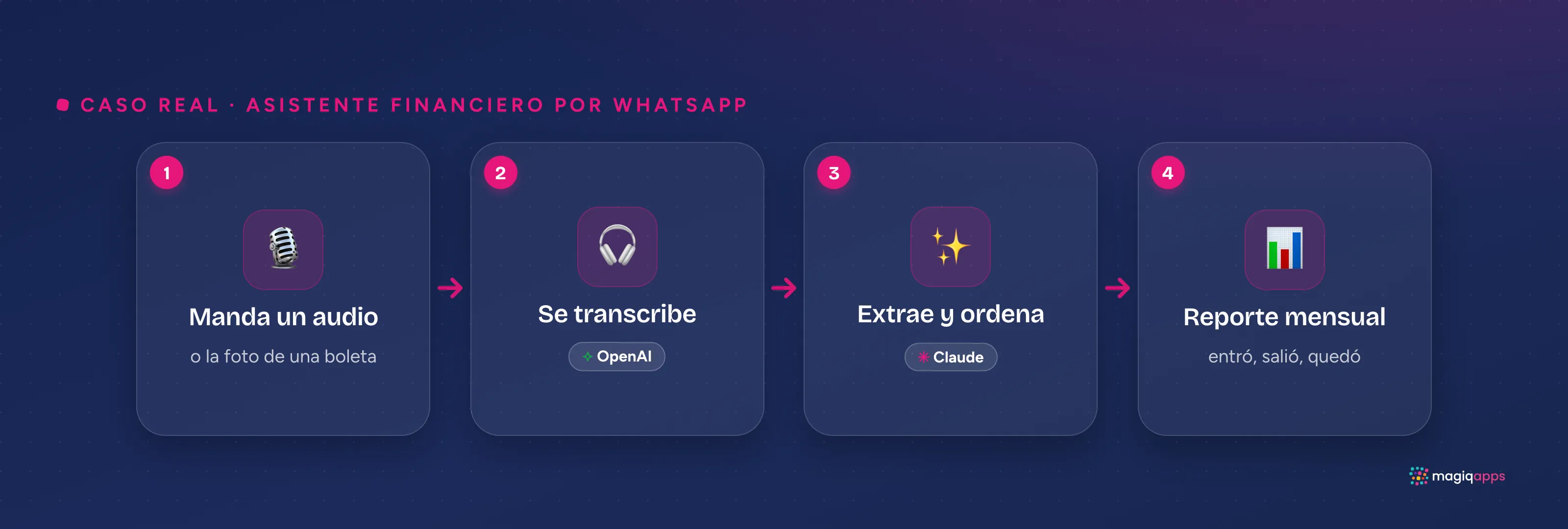
How it looks in practice. A project we built at MagiqApps: a financial assistant over WhatsApp for smallholder farmers, within a rural inclusion program. The producer sends a voice note (“yesterday I paid 90 for labor”) or a photo of a receipt, and the assistant understands and records it. Under the hood, an OpenAI model transcribes the audio tuned to the local Spanish, and Claude (from Anthropic) extracts the expense, classifies it, resolves dates like “yesterday”, and even corrects an earlier entry when the person restates it, all in a single pass. It separates the farm economy from the household economy, and each month it builds a simple report of what came in, what went out, and what was left. It is made for people who are new to technology: audio rules, it tolerates messy input, it confirms in plain language, and if something is not understood a couple of times, it offers help and hands off to a person. It runs directly on Meta’s Cloud API and uses the 24-hour window, so that design also protects the cost.
Meta pushed this wave with its own Business Agent (globally available since June 2026): a no-code agent that answers, recommends from the catalog, and books. It is a good starting point and, by design, it is generic. The value jump appears when the agent connects to the company’s own systems (your ERP, your CRM, your order base), and that is where custom software comes in.
One detail many missed that defines the strategy: in January 2026 Meta barred general-purpose chatbots on the platform (pasting a “generic ChatGPT” onto WhatsApp is no longer allowed). Business-specific assistants are still fully allowed. The right reading is clear: the future is an agent tied to your business, your data, and your processes.
That is also where AI becomes an executor. Emerging standards like MCP (the open protocol to connect AI models with tools and data) let the agent act on your systems with scoped permissions. It is still early infrastructure, and it marks the direction: the assistant stops “just answering” and starts resolving.
How we think about it at MagiqApps
Our rule is simple and we apply it in every project: when a process always follows the same rules, the best tool is a good program, it runs the same and costs little. We reserve AI for what changes: understanding language, classifying, deciding a new case, having a conversation. That mix, judgment plus code, is what delivers automation that truly works without overpaying.
In practice: we start with one concrete use case (support, order tracking, scheduling, lead qualification), integrate it with your systems, measure it, and always leave the door open to a person. From idea to a working pilot in two weeks.
Are you automating WhatsApp this year? Let’s talk.
- Automation
- AI agents