Product
Social listening for institutions: knowing what's being said, today
Reputation is shaped in real time across social media and news. What social listening is, and how Vigía makes it actionable in Spanish and the Peruvian context.
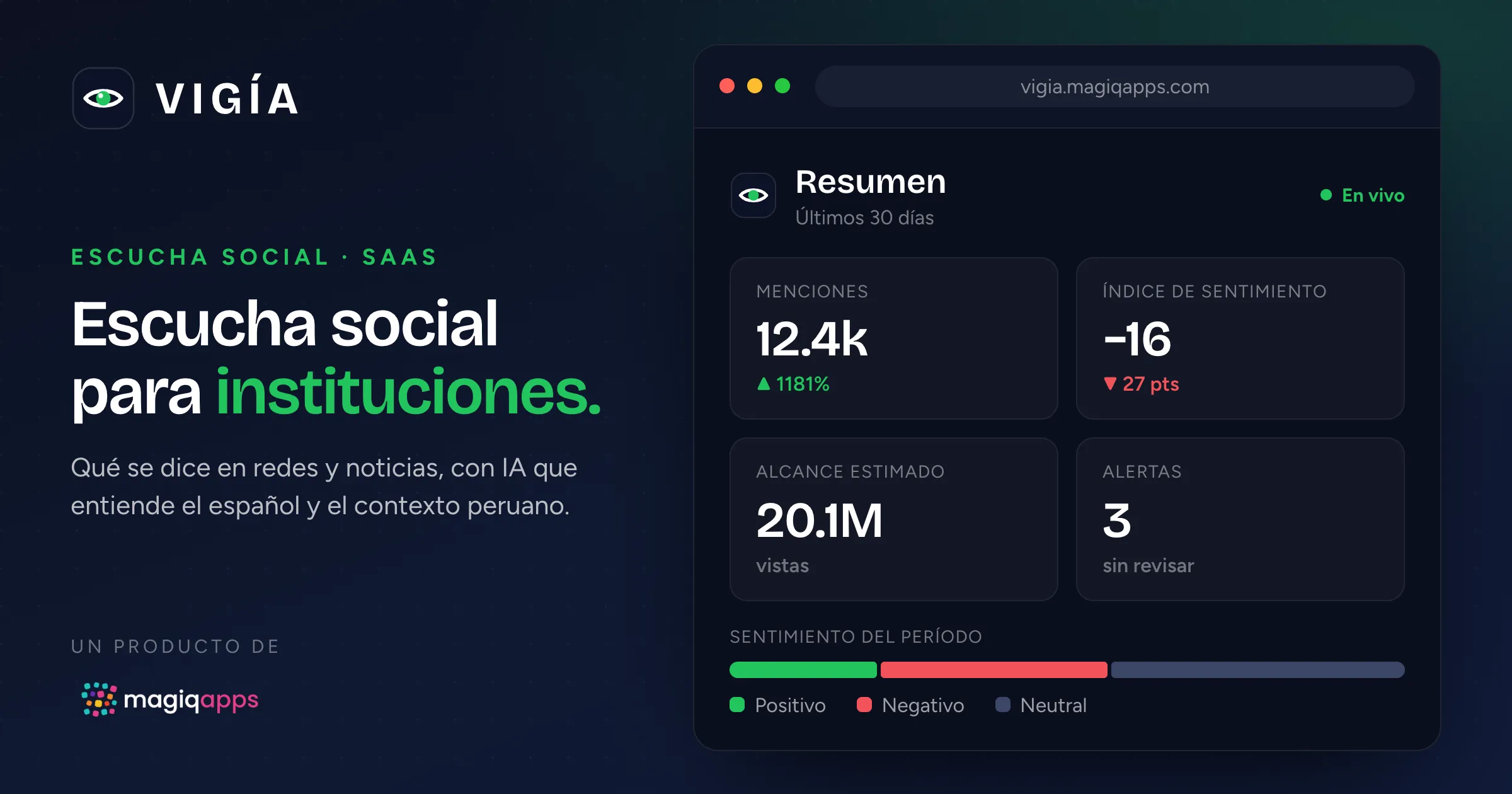
Every day, thousands of conversations mention an institution across social media, forums and the news. Some praise, some complain, and a few can ignite a crisis within hours. The data exists; the trouble is that it arrives scattered, late, and nobody has time to read it all.
Social listening solves exactly that. This article explains what it is, why Spanish and the Peruvian context change the outcome, and how we approach it with Vigía, our own platform.
What social listening is
Social listening is the continuous monitoring of what people say about a brand, an institution or a topic across public channels: social media, news, blogs and comments. The idea is simple: gather those mentions in one place, understand the tone of each one, and catch what deserves attention in time.
Done well, it stops being a vanity board and becomes a decision tool. It answers concrete questions:
- What is being talked about right now, and how intensely?
- Is the overall tone rising or falling this week?
- Is there a story growing that is worth addressing before it escalates?
- Is the conversation organic, or does it look like a coordinated campaign?
Why Spanish and the Peruvian context matter
Doing social listening in Peru works when the tool understands how people talk here. Most social listening tools were born in English and translate the rest. With Spanish that shows: irony, slang and sarcasm change the meaning of a sentence completely. A “what wonderful service” can be sincere praise or a biting complaint, and only context makes it clear.
In Peru there is another layer: local names, regional slang, current events, and the particular way people criticize or acknowledge a public institution. Vigía was built with that in mind. Its AI is tuned to understand Spanish and the signals of the Peruvian context, so the sentiment it reports reads the way a person would read it.
From loose mentions to decisions
Gathering mentions is the first step. The value appears when those mentions are organized for action. Vigía works across six fronts:
- Multi-source monitoring. Social media and news in a single stream, with no tab-hopping.
- Sentiment in Spanish. Every mention read for its tone and local context, classified as positive, neutral or negative.
- Citizen voice. Questions, complaints, requests and reports, grouped and actionable.
- Trolls and campaigns. Signals of coordination and inorganic behavior, to tell a real crisis from an inflated one.
- Regional map. Where the conversation concentrates across the country.
- Alerts and reports. Notices when something moves fast, and summaries ready to share with leadership.
What it looks like in practice
Picture the last 30 days for an entity. Mentions spike after a news story, the sentiment index drops a few points, and three alerts sit unreviewed. In the list of what matters most you find a press note about service delays, the announcement of a new campaign, and a video praising the team’s fast response.
With that picture on a single screen, the decision no longer depends on intuition. The team knows what to address first, what tone to respond with, and whom to involve. (The figures in this example are illustrative and anonymized.)
Who it is for
Vigía is built for public and private institutions that need to understand their reputation in real time: communications, press, citizen-service and leadership teams. It is in production today, serving organizations that make decisions with the public conversation as an input.
If you would like to see how it would look for your institution, request a demo or explore Vigía. We prepare a view with the sources and topics relevant to your case.
- Vigía
- Social listening
- Applied AI